
SPRAY FOAM INSULATION
Sustainability. Durability. Energy efficiency.
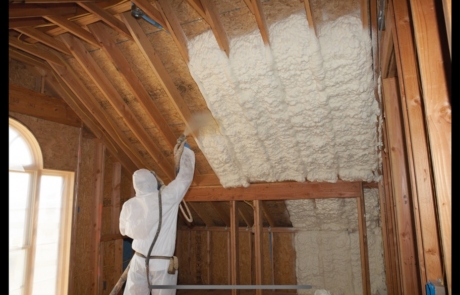
Spray foam is the most modern, affordable and practical investment you can make in your home or business. It produces no seams and stops air and moisture in their tracks. It can be used on your roof, attic, wall cavities, duct work and more. Here’s what you’ll notice: a drop in your energy bills, and a home protected from mold, airborne pollutants and allergens—and a substantial step up in comfort. Plus, you’ll have the peace of mind that you’ve strengthened your home structure and invested in it home for the long run. Also, you can protect spray foam with elastomeric coatings, which are tough, resilient to water and humidity, and scratch resistant.
Garrity Insulation has been servicing the state of New Mexico as a residential and commercial insulation contractor for more than 30 years. You say it, we spray it!
Spray foam insulation has the highest R-value per square inch of any commercially available insulation material.


Stop air infiltration.
Air infiltration is a major cause for high home energy bills. Today there are many techniques to help seal off these costly leaks and alleviate these problems.

Reduce heating and cooling costs.
A home’s energy efficiency rides on proper air sealing, insulation, moisture control and ventilation. Air sealing efforts will compliment these efforts, and vice versa.

Invest in your home.
Make your home more attractive to potential buyers. Most buyers list energy-efficiency as a prime consideration in their purchase.

Reduce Noise
Outside noise causes stress, poor concentration and fatigue. Insulation within walls, ceilings, floors and ducts significantly reduces the amount of noise inside commercial buildings.
Spray Polyurethane Foam (SPF) FAQ
What is spray polyurethane foam?
Spray polyurethane foam, commonly known as spray foam insulation, is a high-performance insulation material that expands after application to fill gaps, cracks, and irregular spaces.
Because it expands and adheres directly to the surfaces where it is applied, spray foam can provide both insulation and an effective air barrier.
Spray foam is available in two primary types: open-cell and closed-cell foam. Each offers different performance characteristics and is suited to different applications.
What is the difference between closed-cell and open-cell spray foam?
The primary differences between closed-cell and open-cell spray foam are their density, R-value, moisture characteristics, rigidity, and cost.
Closed-Cell Spray Foam
- Dense and rigid
- Higher R-value per inch
- Provides excellent air sealing
- Highly resistant to water
- Can provide vapor-control benefits at appropriate thicknesses
- Adds rigidity to certain assemblies
- Ideal when space is limited or greater moisture resistance is required
Open-Cell Spray Foam
- Lightweight and flexible
- Lower R-value per inch than closed-cell foam
- Excellent air-sealing properties
- Vapor permeable
- Excellent for sound absorption
- Expands significantly to fill cavities
- Typically less expensive than closed-cell foam
Should I use closed-cell or open-cell spray foam for my project?
The right spray foam depends on the location, building design, moisture conditions, energy goals, and budget.
Closed-cell spray foam is often a good choice for exterior walls, roof assemblies, metal buildings, and areas where space is limited or greater moisture resistance and R-value per inch are important.
Open-cell spray foam can be an excellent option for certain interior wall, attic, and sound-control applications where flexibility, air sealing, sound absorption, and cost are priorities.
Every building is different. Garrity Insulation can evaluate your project and recommend the insulation system that best fits the application, performance requirements, and budget.
OUR TRUSTED PARTNERS


